Towermaxxing
You are the tower. Build something unstoppable.
Description
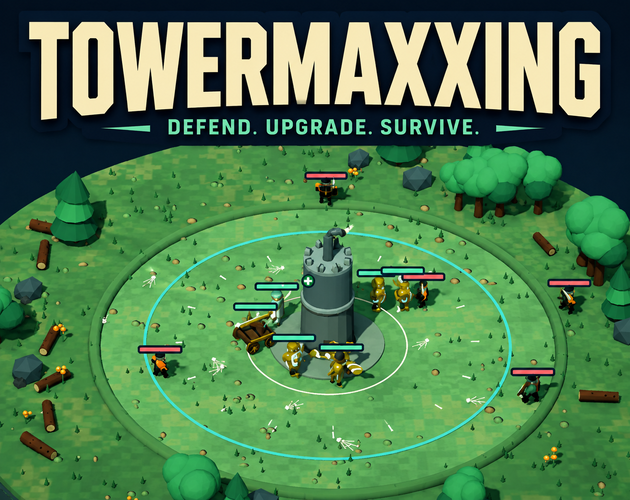
You are the tower. Build something unstoppable. Your cannons fire, you call the shots: upgrade your defenses, recruit an army, and unleash powerful abilities against waves of enemies. Mix weapons, auras, and elemental effects to discover your favorite way to control the battlefield.
Battle through 100 worlds and defeat bosses. Watch your humble Keep evolve into an extravagant Maxxed Monument, with every new stage giving you something bigger to fight for.
Save and share your strongest builds, invest in permanent upgrades, and come back ready to push further.
I started out by having Claude Opus 4.8 work on a scaffold for a game in Phaser.
First prompt:
``using Phaser.js, found at https://github.com/phaserjs/phaser/releases/download/v4.2.1/phaser.js - build scaffold for a tower defense game, that is builds successfully, with a menu and the ability to start the game. In this tower defense game you have a single tower in the middle of the screen that has multiple upgrades available. There are different projectile types that you can choose from that can each be independently upgradable. Each of the projectile types have different effects on the enemies, such as ice type slows down enemies, electric type causes enemies to briefly be stunned in place, fire type adds damage over time. The enemies come in waves from all directions, and attack the tower if they get in range. Some enemies can attack from a distance, while others can only attack when they reach the tower. When enemies are killed, the player receives gold, which is used for upgrades to the tower.``
I iterated on the game for a while, then wrote up a technical spec describing all of the features and functionality I had built up until that point and I gave Astra the spec and simple instructions to implement this game in Godot, and to use Blender to create basic 3d models (they were originally made in Three.js, from claude). I was very impressed with the results and have not looked back. I have used the various levels of thinking for astra depending on the task, and so far, I have noticed the "light" mode has like a different toolchain or something, and is not consistent with the other modes. It has been able to handle modeling, gameplay loops, responsive UI, and many performance optimizations so the game works smoothly on mobile, even with 100s of enemies. The freedom that comes from going from idea->implementation in a matter of minutes is very satisfying.
More in Games